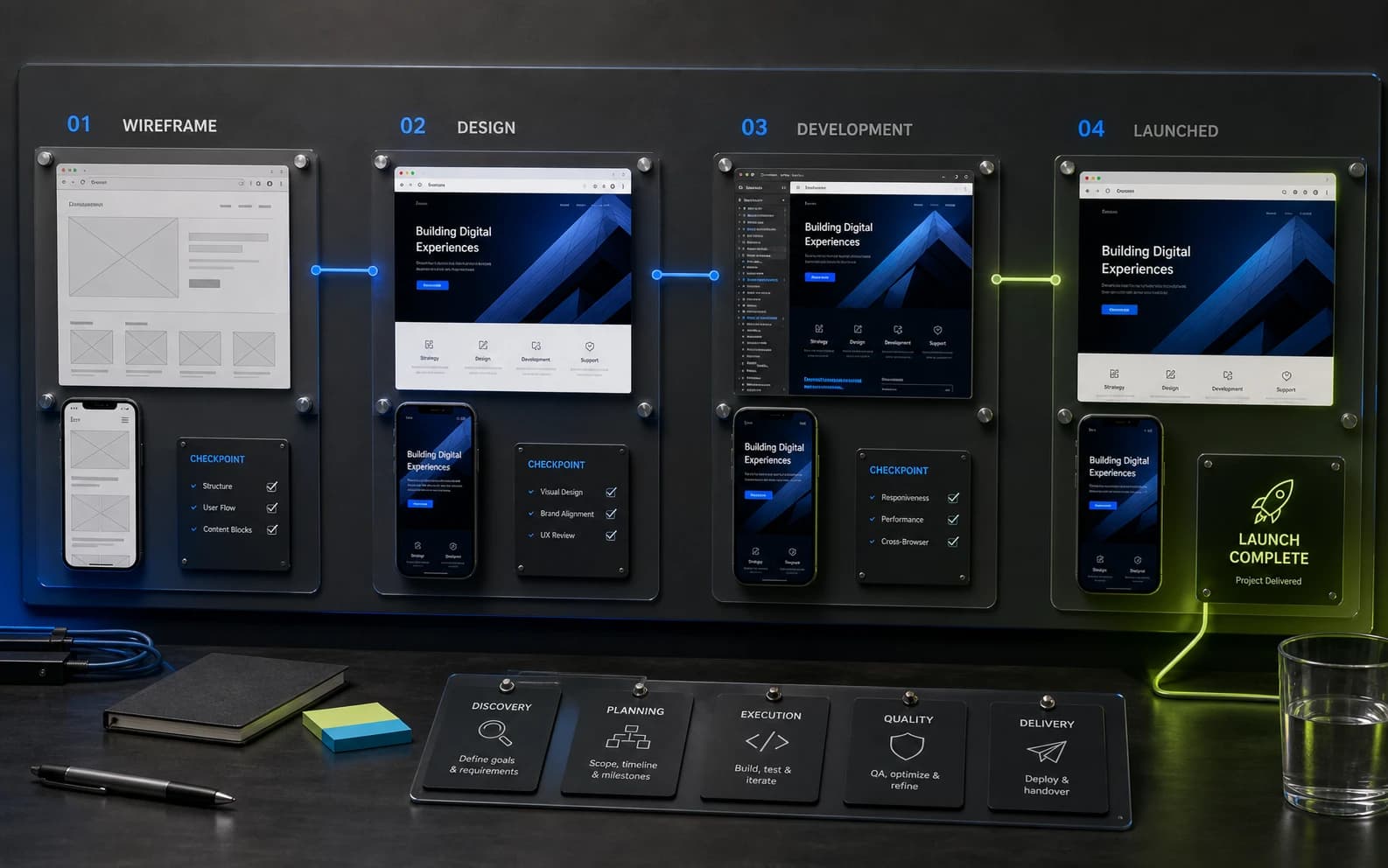
Outsourcing is not handing a folder to a developer and hoping for a launch date. It is a production system that translates a campaign promise into requirements, design, tested code and measurable conversion events.
A strong external team should increase the agency’s control: fewer unknowns, visible progress, documented decisions and a reliable route from brief to post-launch optimisation.
Key takeaways
- Business goal and conversion
- Page and content ownership
- Integrations and data flows
- Acceptance criteria
01
Start with a brief developers can actually build
State the business goal, audiences, traffic sources, required actions, content owner, languages, integrations, analytics events, approval chain and fixed launch constraints. Link every requested feature to a customer or operational need.
- Business goal and conversion
- Page and content ownership
- Integrations and data flows
- Acceptance criteria
02
Use checkpoints instead of one final reveal
Approve the sitemap before wireframes, wireframes before visual design, and responsive behaviour before full content entry. Weekly demos and a written decision log expose risks while changes are still inexpensive.
03
Design handoff must describe behaviour, not only pixels
A production-ready design system includes components, states, mobile layouts, content rules, animations and error conditions. It also identifies reusable patterns so the developer is not forced to invent the product while estimating it.
- Desktop and mobile states
- Component and token library
- Form and error states
- Asset and font licences
04
Plan launch, ownership and support before coding
Agree who controls domains, hosting, repositories, analytics and third-party accounts. Define redirects, backups, monitoring, warranty and the response process after launch. A clean handover prevents the agency from becoming permanent unpaid support.
Trusted references